
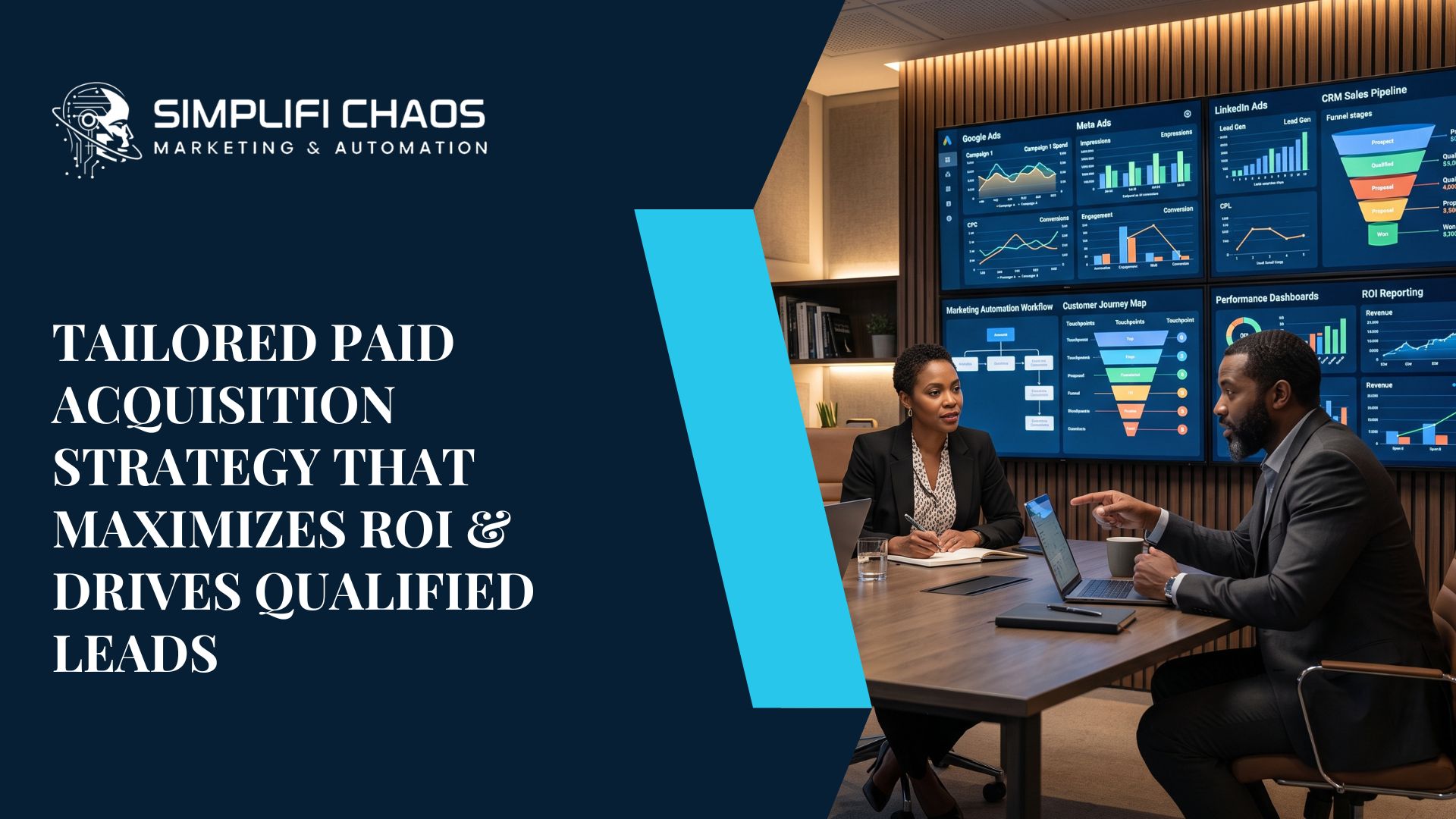
Tailored Paid Acquisition Strategy That Maximizes ROI & Drives Qualified Leads
Your ads are getting clicks. Your dashboard shows traffic, impressions, maybe even a decent click-through rate. But leads? Real, sales-ready leads? Those are nowhere to be found, and it's draining your budget every single day this keeps happening. A tailored paid acquisition strategy solves this exact problem, not by spending more, but by fixing the disconnect between your ads, your funnel, and your follow-up. This guide walks through what that actually means, why generic campaigns keep failing, and how a properly built system turns traffic into a pipeline you can actually count on. Let's start with why most paid ads never make it past the click.
What a Tailored Paid Acquisition Strategy Actually Means
A tailored paid acquisition strategy isn't a bigger ad budget or a fancier headline. It's a plan built around your specific offer, your specific audience, and your specific sales process, instead of a generic template applied to every client the same way.
That distinction shows up in the details. Audience targeting reflects who actually buys from you, not just who fits a broad demographic. Ad messaging matches how your buyers actually talk about their problem. Platform selection is based on where those buyers spend their time, not wherever's cheapest to run ads that week.
The result is a system where every piece connects to the next: targeting feeds the right traffic into the right funnel, and that funnel is built to convert the specific person it's designed for. Generic campaigns skip this step entirely, which is exactly why so many of them stall out after the click.

Why Most Paid Advertising Strategy Efforts Fall Apart After the Click
Once you understand what a tailored approach actually looks like, it's easier to see exactly where most paid advertising strategy efforts break down instead.
Targeting That's Too Broad to Convert
Broad targeting feels efficient because it reaches more people for the same spend, but reach isn't the same as relevance. When an ad shows up in front of someone who was never going to buy in the first place, the click still costs money, it just doesn't lead anywhere. Tighter targeting, built around real buyer characteristics rather than surface-level demographics, tends to cost more per click and far less per actual customer. That tradeoff is uncomfortable at first, but it's usually the right one.
Landing Pages Built for Looks, Not Leads
A beautiful landing page that doesn't convert is still a landing page that's losing you money. Plenty of pages get built around brand aesthetics, long paragraphs, and generic stock photography, none of which actually moves someone toward filling out a form. Conversion-focused pages are built around a single, clear action, with messaging that mirrors exactly what the ad promised. Anything that distracts from that one action is usually cut, no matter how good it looks.
No Follow-Up Once the Form Gets Submitted
A submitted form isn't a closed deal, it's the start of a conversation that most businesses accidentally let go cold. Without automated follow-up, a lead might wait days for a response, and by then, they've often already talked to someone else. This is one of the most common, and most fixable, reasons paid traffic doesn't turn into revenue. A system that routes and follows up with leads immediately closes a gap that costs businesses real money every single week.
What Goes Into Building a Real Customer Acquisition Campaign
With those failure points in mind, it helps to see exactly what a properly built customer acquisition campaign actually includes, piece by piece.
A clear audience profile. Not just age and location, but the specific problem, budget, and buying stage of the person you're trying to reach.
Platform-specific creative. An ad that works on Google search rarely works the same way on Meta or TikTok, so creative gets built for where it will actually run.
A conversion-focused landing page. One clear offer, one clear action, and messaging that matches exactly what got someone to click in the first place.
Automated lead capture and routing. Every lead gets qualified and sent directly into your sales pipeline, without manual handoffs that slow things down.
Conversion tracking from day one. Knowing exactly which ad, keyword, and platform produced a lead makes every future decision more accurate.
A built-in feedback loop. Performance data feeds back into targeting and creative decisions, so the campaign gets sharper over time instead of staying static.

How PPC Management Services Turn Ad Spend Into Pipeline
Building the campaign is one part of this. Managing it well after launch is where PPC management services actually earn their value, since a campaign left alone rarely performs the same way for long.
Platform Selection Based on Where Your Buyers Actually Are
Not every platform fits every business, and spreading budget across all of them evenly is rarely the smartest move. Google Ads tends to work well for buyers actively searching for a solution, while Meta and TikTok are often stronger for reaching people earlier in their decision, before they're actively searching at all. LinkedIn carries its own advantage for B2B offers where job title and company size matter more than general interest. Getting this selection right upfront saves a significant amount of wasted spend later.
Bidding and Budget Decisions That Protect ROI
Bidding strategy quietly determines how much you pay for each result, and getting it wrong can drain a budget without anyone noticing until the numbers are reviewed. Automated bidding tools help, but they still need real oversight, since an algorithm optimizing for clicks isn't automatically optimizing for actual revenue. Budget also needs to shift toward what's working and away from what isn't, rather than staying evenly split just because that's how it started. This kind of active management is what separates a campaign that improves over time from one that just runs on autopilot.
Ongoing Optimization Instead of Set-and-Forget
A campaign that launches well and then gets left alone almost always declines in performance within a few weeks. Ad fatigue sets in, audiences shift, and competitors adjust their own bidding, all of which quietly erode results if nobody's watching. Regular testing, on ad creative, targeting, and landing pages, is what keeps a campaign improving instead of slowly losing ground. This is usually the difference between a campaign that gets more expensive every month and one that gets more efficient.
Where Conversion Rate Optimization Fits Into the Bigger Picture
Managing the ad spend well only matters if the traffic it produces actually converts once it lands, which is exactly where conversion rate optimization comes in.
Small changes, meaningfully bigger results. A headline change, a shorter form, or a repositioned call-to-action can noticeably shift conversion rates without touching the ad spend at all.
Testing beats assuming. What performs well for one industry or offer doesn't automatically transfer to another, which is why real testing matters more than best-practice guesses.
Friction is the enemy. Every extra form field, every unclear next step, gives a visitor one more reason to leave before converting.
Speed genuinely matters. A slow-loading landing page loses visitors before they even see the offer, regardless of how strong the ad was.
Trust signals do real work. Testimonials, clear guarantees, and transparent pricing all reduce hesitation at the exact moment someone's deciding whether to convert.
Optimization compounds. A one or two percent lift in conversion rate, applied consistently, adds up to a meaningfully larger pipeline over several months.
Why Multi-Channel Digital Advertising Outperforms a Single-Platform Bet
With conversion handled well on the landing page side, the next consideration is where that traffic comes from in the first place, and relying on just one platform is a riskier bet than it looks.
Reaching Buyers at Different Stages
Someone actively searching on Google is ready to act now, while someone scrolling Meta or TikTok might not even know your solution exists yet. Relying on a single platform means only capturing buyers at one specific stage of their decision, missing everyone earlier or later in that process. A multi-channel approach captures interest at multiple points along that journey instead of just the final one. That difference alone often accounts for a meaningful share of missed opportunity.
Reducing Dependence on One Algorithm
Every platform changes its algorithm, its costs, and its rules over time, sometimes without much warning. A business relying entirely on one platform is exposed to whatever changes that platform decides to make next, with no backup plan if performance suddenly drops. Spreading acquisition across two or three channels means a shift on one platform doesn't take down the entire pipeline. It's a simple form of risk management that a lot of businesses only think about after the fact.
Compounding Data Across Channels
Running campaigns across multiple platforms produces more data, and more data means faster, more accurate decisions about what's actually working. Patterns that show up on one platform can inform creative and targeting decisions on another, even when the platforms themselves work differently. Over time, this cross-channel visibility becomes a genuine advantage, since it reveals what's true about your audience overall, not just what's true on one specific platform. That broader picture is hard to get from a single-channel approach alone.
What Results Actually Look Like Once the System Is Running
With the strategy, the management, and the multi-channel approach all working together, it's worth being specific about what actually changes once a system like this is fully in place.
Cost-per-lead trends downward over time. Instead of staying flat or creeping upward, a properly optimized system tends to get more efficient the longer it runs.
Lead quality improves noticeably. Sales teams spend less time on unqualified conversations and more time with prospects who are genuinely a fit.
Pipeline becomes more predictable. Instead of feast-or-famine months, lead flow evens out into something closer to a consistent, forecastable number.
Reporting actually means something. Clear attribution shows exactly which campaigns, platforms, and keywords are producing real revenue, not just traffic.
Scaling feels less risky. Once a system is proven to work at a smaller budget, increasing spend becomes a calculated decision instead of a gamble.
Final Thoughts
Clicks were never the goal, revenue always was, and the gap between the two comes down to strategy, not just spend. A tailored paid acquisition strategy connects targeting, funnels, and follow-up into one system built around actual results. SimpliFi Chaos can help you turn wasted ad spend into a real, predictable lead pipeline.
Frequently Asked Questions
1. What makes a paid advertising strategy actually effective?
An effective paid advertising strategy connects targeting, ad creative, landing pages, and follow-up automation into one system, rather than treating each piece separately. Businesses that see consistent results typically test and refine each of these elements together instead of focusing only on the ad itself.
2. What does a customer acquisition campaign typically include?
A customer acquisition campaign typically includes audience research, platform-specific ad creative, a conversion-focused landing page, and automated lead routing into a sales pipeline. The strongest campaigns also include conversion tracking from launch, so performance data can guide ongoing adjustments.
3. Are PPC management services worth it for a small business?
PPC management services are often worth it once ad spend reaches a level where inefficiencies genuinely cost money, since ongoing bid, budget, and creative adjustments usually improve ROI more than a set-and-forget campaign. For very small budgets, the value depends on how competitive the specific industry and keywords are.
4. How does conversion rate optimization improve lead generation results?
Conversion rate optimization improves lead generation by increasing the percentage of visitors who take action, without requiring any additional ad spend. Even small improvements to landing page speed, messaging, or form length can meaningfully increase the number of leads generated from the same traffic.
5. Is multi-channel digital advertising better than focusing on one platform?
Multi-channel digital advertising generally outperforms a single-platform approach because it reaches buyers at different stages of their decision and reduces dependence on any one algorithm's changes. Businesses that diversify across two or three platforms tend to see more stable lead flow than those relying entirely on one channel.


